https://www.abeneth.com/the-ultimate-guide-to-luxury-bedding-and-high-end-bedroom-makeovers/
When preparing to upgrade the soft furnishings of their bedroom, many people’s first reaction is: buy more expensive bedding and hang thicker curtains, and the room will instantly transform into a five-star hotel.
But reality often doesn’t cooperate.
You carefully select a 100-count long-staple cotton four-piece bedding set, but after laying it down, a strange “cheap” feeling washes over you; you also change the curtains to the kind with 100% blackout coverage, but the whole space still lacks the “relaxed yet sophisticated” feeling you expected.
The problem isn’t actually with the budget, but with the visual logic .
Bedding, curtains, and carpets in the bedroom occupy more than 60% of the visual area. They are not just simple tools, but the “base makeup” of the entire room. If you just randomly choose colors based on your preferences, it’s easy to give the bedroom a “budget hotel-style patchwork feel.”
To truly elevate the ambiance of a space with home textiles, we need to adopt a designer’s perspective, working backward from the overall atmosphere to determine the materials and colors. By leveraging the aesthetics of color matching within the interior space , we can transform the bedroom into a living environment that fosters emotional stability.
Below, we’ll break down several practical, simple, and extremely cost-effective home textile matching formulas to help you transform your bedroom at a very low cost.
I. Color Logic: Bedding is the largest “color block” in the bedroom.
Don’t underestimate the importance of bedding. It’s not just a duvet cover; it’s the “visual focal point.”
1. The 60-30-10 Golden Color Rule
In interior design, colors are typically divided into primary colors (60%), secondary colors (30%), and accent colors (10%). Bedding in the bedroom usually plays the role of either the primary or secondary color.
Scenario A: The walls are plain white.
White walls are clean, but also empty.
Choosing bedding in neutral colors such as caramel, olive green, or dusty blue can instantly create a more atmospheric feel in the room.
Scenario B: To achieve an ultimate sense of tranquility,
try tones-on-tone transitions within the same color family.
For example: light gray walls + dark gray bedding + silver-gray carpet.
This subtle nuance is the easiest way to create a “high-end” feel.
2. Avoidance Guide: Use Large-Area Prints with Caution
Unless you’re a master of color matching, don’t easily opt for bed sheets with large floral patterns or bold color blocks.
Solid colors, thin stripes, and fine checks are timeless and the most forgiving choices.

II. Layering Materials: Creating Visual Depth
Why do beds in magazines look so soft and plush?
The secret lies in the combination of materials, not just a single type of cotton fabric.
1. Use “material conflict” to add depth.
Observe the background of your bed:
If the headboard is made of a “hard + glossy” material like leather or wood
, then choosing bedding made of “soft + matte + textured” materials like washed cotton, linen, or double-layered yarn will create a particularly balanced look.
This contrast between “light vs. matte, hard vs. soft” is key to visual hierarchy.
2. The three-layer stacking method instantly elevates the bed’s look.
Designers often use this trick:
Bottom layer (function): Pure cotton brushed or high-count cotton (for skin-friendly feel)
Middle layer (luster): 2 velvet/corduroy throw pillows (for highlight)
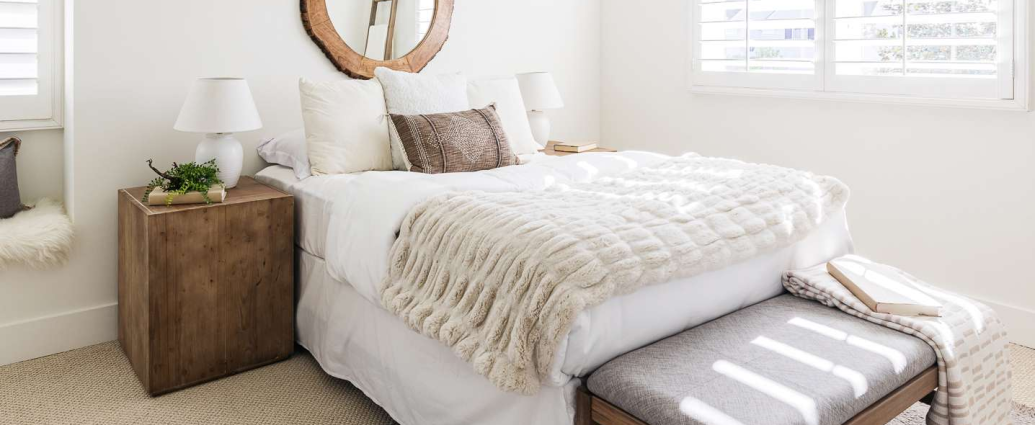
Top layer (volume): A chunky knit or faux fur bed runner (for fluffiness)
With three textures combined, even affordable bedding can look incredibly high-end.
III. Curtains and Carpets: Bedroom “Makeover”
Bedding is like the base makeup, while curtains and carpets are like “highlighter and contouring”.
1. Curtains: From ceiling to floor, creating the illusion of a spacious apartment.
Biggest misconception: Hanging curtain rods on window frames.
That’s a practice in rental properties.
Correct method:
Start the curtain rod from the bottom of the ceiling, and let the curtains hang down to the floor (or even slightly drag on the floor by 2cm).
This visual stretching effect can instantly make a small bedroom appear taller and larger.
2. Carpets: The larger the size, the more stable the layout.
Small rugs will only make a room feel cramped.
Correct size: The rug should cover at least one-third of the front of the bed foot and extend to the left and right sides.
This not only makes the bed feel softer underfoot, but also allows the bed and floor to form a unified “rest island”.

IV. Throw Pillows and Blankets: The Cheapest and Fastest Style Switchers
If you don’t want to make any major changes, then cushions and blankets are the lowest-cost way to upgrade.
Spring/Summer : Silk, Satin, Cream Yellow, Mint Green;
Autumn/Winter : Teddy Fleece, Wool, Caramel, Burgundy
Just by changing a few small items, you can change the seasonal atmosphere of the entire room.
Conclusion
Home textiles are not just a supporting element; they are an “emotional expression” of a home.
The hard furnishings determine the framework of a space, while home textiles give a room its warmth.
As long as you master the logic of color, the layering of materials, and the visual proportion of large areas of soft furnishings, you can create a “magazine-quality” bedroom with a very low budget.
Instead of worrying about the budget, why not start by changing to the right bedding?
https://www.abeneth.com/the-ultimate-guide-to-luxury-bedding-and-high-end-bedroom-makeovers/